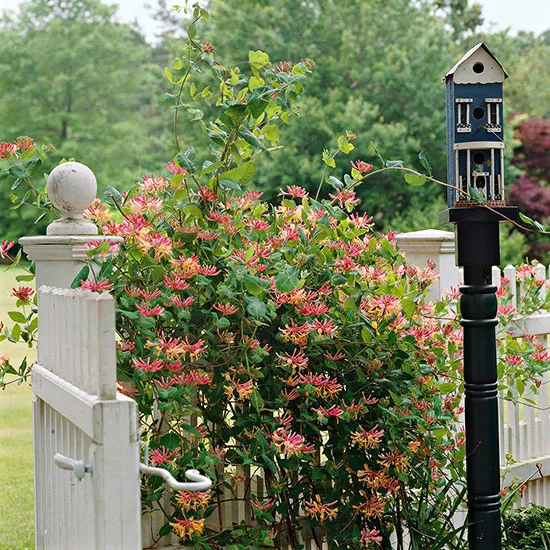
Hummingbirds adore honeysuckle vines, and after growing one, you will, too. These easy-care climbers offer attractive clusters of blooms in white, yellow, orange, and red shades, and the sweet scent of many varieties is a welcome treat. The tube-shaped flowers look great mixed in with shrubs, perennials, and annuals. Honeysuckle vine usually goes dormant in the winter.
All parts of the honeysuckle vine are mildly toxic for pets.
Honeysuckle Vine Overview
| Genus Name | Lonicera |
| Common Name | Honeysuckle Vine |
| Plant Type | Vine |
| Light | Sun |
| Height | 10 to 25 feet |
| Width | 3 to 15 feet |
| Flower Color | Pink, Red, White |
| Foliage Color | Blue/Green, Chartreuse/Gold |
| Season Features | Fall Bloom, Summer Bloom |
| Special Features | Attracts Birds, Fragrance, Low Maintenance |
| Zones | 4, 5, 6, 7, 8, 9 |
| Propagation | Layering, Seed, Stem Cuttings |
Where to Plant Honeysuckle Vine
Plant honeysuckle vine in moist but well-drained soil. If possible, locate it where its roots are in the shade and stems are in the sun, such as against a west-facing wall or fence. As it grows, the vine needs a sturdy support such as a trellis, fence, or pole. Install the support before planting the vine to avoid damaging the roots later.
Some honeysuckle vines, such as Japanese honeysuckle (Lonicera japonica), are invasive. However, most honeysuckle vines available to home gardeners in the United States are not invasive, including trumpet honeysuckle (Lonicera sempervirens), yellow honeysuckle (Lonicera flava), and 'Dropmore Scarlett' (Lonicera x brownii 'Dropmore Scarlet'). If in doubt, ask the garden center manager before buying.
How and When to Plant Honeysuckle Vine
Plant honeysuckle in early spring after the danger of frost has passed. Prepare the soil by digging in compost or well-rotted organic matter. Dig a hole for the plant the same size as the rootball. Situate the vine in the hole at the same level as in the container. Backfill with the amended soil as needed, pressing down gently on the soil with your hands to remove air pockets. Water the plant and add a 2-inch layer of mulch around the base of the plant.
Honeysuckle Vine Care Tips
Light
Honeysuckle vine enjoys full sun on its stems and leaves but not so much on its roots, which are more comfortable in shade. In hot regions, supply some afternoon shade.
Soil and Water
Although honeysuckle vine tolerates a range of soil types, it performs best in loamy, well-draining garden soil that has been amended with compost.
Temperature and Humidity
Honeysuckle vine grows best when the temperature is between 55°F and 85°F. It prefers average or low humidity. High humidity encourages fungal infections, like powdery mildew.
Fertilizer
Too much fertilizer prompts the plant to develop more foliage and fewer flowers. When you amend the soil at planting, young honeysuckle vines don't need additional fertilizer that year. Established plants benefit from a single application of general-purpose fertilizer in the spring.
Pruning
Some honeysuckle vines bloom on new growth, and some bloom on old growth. Most early flowering honeysuckle vines bloom on the previous year's growth, so you don't want to heavily prune the plant for the winter. The best time to prune honeysuckle vine is right after the flowers drop, and the lighter the pruning, the more flowers will appear the following spring.
Knowing which type you have before pruning it is essential, or you may cut away the stems destined to carry next year's blooms. No matter which kind you have, pruning away dead wood does no harm and makes the plant look better.
Potting and Repotting
Honeysuckle vine grows well in containers. Select a container with excellent drainage and fill it with potting soil. Add a support to the container before planting unless you plan to locate it near a fence or other structure it can climb. As an option, sit the container on a pillar or table and let the vines cascade over the side. Dig a hole the same size as the rootball. Place the honeysuckle vine in the hole and firm the soil around it. Sprinkle a granular, balanced fertilizer such as a 10-10-10 on the soil and water it. If it becomes necessary to repot the plant, do so in the fall while it is dormant.
Pests and Problems
Aphids and spider mites will feed on honeysuckle vines. Identify and treat them quickly to prevent an infestation. Fungi-caused cankers and powdery mildew are the result of soggy soil. Discard or relocate the damaged plants to a better-draining part of the garden.
How to Propagate
Home gardeners can propagate honeysuckle vine via stem cuttings, layering, and seed.
Stem cuttings: In late spring, early in the morning, cut 6-8 inches from the end of a two-year-old vine, making the cut at an angle just below a leaf node. Be careful not to crush the vine. Remove the bottom sets of leaves, and dip the stem cutting in rooting hormone. Insert the cutting into a pot filled with potting soil and place it in a warm, bright location. Keep the soil moist. When new growth appears, the plant has rooted.
Layering: If you have an existing honeysuckle vine, it is easy to create another one by layering. In the spring, bend a vine to the ground. Where it touches, carefully scratch the side that touches the soil with a knife. Dip the area that is scratched into rooting hormone. Dig a small hole where it touches the ground and add potting soil to bury the part of the vine that is scratched, weighing it down with a rock if needed. In time, you'll see new growth from the buried location. Cut the vine attached to the new plant to free it from the parent.
Seed: Seeds can be harvested from a mature honeysuckle vine after its flowers produce small berries. Only ripe berries contain seeds, so don't pick any green ones. Crush the berries in a small bowl. Separate the seeds from the flesh, rinse them in water, and put them on a paper towel. Honeysuckle vines must go through a period of cold stratification before they will germinate. Either plant them in the fall and let winter supply the cold period, or put the seeds and moist sphagnum moss in a plastic bag with a couple of holes punched in it for ventilation. Then, put the bag in the refrigerator for about two months.
Types of Honeysuckle Vine
Common Honeysuckle Vine
Common honeysuckle (Lonicera periclymenum) bears intensely fragrant white or pink flowers from mid to late summer. It also provides birds with colorful red fruits. It climbs to 25 feet and is not invasive. Plant in zones 5-9.
'Dropmore Scarlet' Honeysuckle Vine
Lonicera x brownii 'Dropmore Scarlet' bears slightly fragrant crimson-red flowers all summer. It climbs to 12 feet and is not invasive. Plant in zones 4-9.
'Gold Flame' Honeysuckle Vine
Lonicera x heckrottii 'Gold Flame' is a strongly growing vine with fragrant yellow flowers all summer. It climbs to 15 feet and is not invasive. Plant in zones 6-9.
Yellow Honeysuckle Vine
Lonicera sempervirens f. sulphurea bears clusters of golden-yellow flowers throughout the summer and into fall. The blooms are followed by attractive red fruits. It climbs to 12 feet and is not invasive. Plant in zones 4-9.