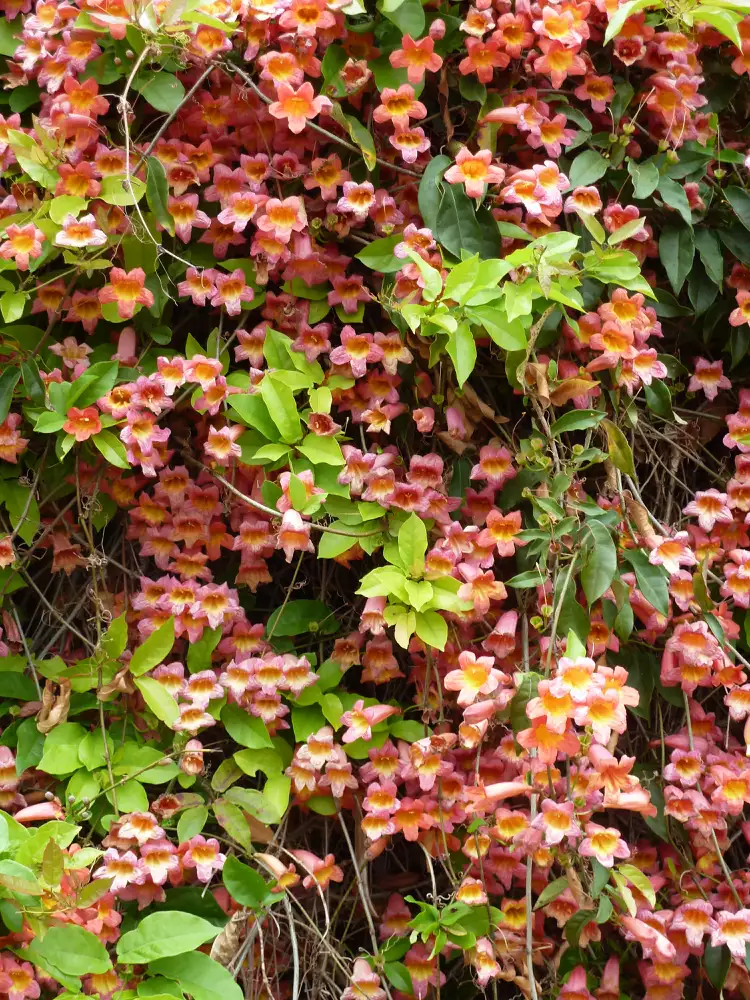
When you need to dress up an unsightly building or repaint a fence, skip the hardware store and track down a crossvine. The easy-to-grow woody vine—a close relative of trumpet vine (Campsis radicans)—clings to most any surface thanks to its twining tendrils that end in adhesive disks. Even better, crossvine is fast-growing and adds lush green foliage and stunning red, orange, and yellow blooms that flourish from late spring through summer.
Crossvine Overview
| Genus Name | Bignonia capreolata |
| Common Name | Crossvine |
| Additional Common Names | Cross Vine, Bignonia crossvine, Trumpet Flower |
| Plant Type | Vine |
| Light | Part Sun, Sun |
| Height | 20 to 50 feet |
| Width | 6 to 9 feet |
| Flower Color | Orange, Pink, Red, Yellow |
| Foliage Color | Chartreuse/Gold |
| Season Features | Spring Bloom, Summer Bloom |
| Special Features | Attracts Birds, Fragrance, Low Maintenance |
| Zones | 6, 7, 8, 9 |
| Propagation | Stem Cuttings |
| Problem Solvers | Drought Tolerant, Good For Privacy |
Where to Plant Crossvine
Crossvine is native to the southeastern United States and often grows naturally in woodlands and swampy forests. The fast-growing vine is known to climb as high as 50 feet in favorable conditions—so it’s best to give your crossvine room to grow. In the garden, crossvine is a favorite food source for hummingbirds and other pollinators. Pair crossvine with easy-to-grow perennials and shrubs and host your own backyard nectar buffet. Crossvine also makes a good ground cover in places where you need to stabilize sloped terrain.
Allow crossvine to stretch across trellises, fences, and arbors if you want to quickly blend into natural landscapes. The native vine is an excellent alternative to non-native climbers (like Japanese honeysuckle or English ivy) which can choke out trees and swiftly become unmanageable. It’s worth noting, however, that crossvine is highly flammable. If you live in an area prone to wildfires, consider planting it a safe distance from your home or other structures.
How and When to Plant Crossvine
To plant your bignonia crossvine, wait until early fall and dig a hole twice as wide and just as deep as the plant's root ball. You want the top edge of the roots to sit at or slightly above ground level. Set your plant in the hole and fill the hole halfway with soil. Tamp down the soil to remove any air pockets and soak the soil. Continue filling the hole and tamping down the soil, but do not cover the top of the root ball. Water thoroughly and keep the soil evenly moist, but not wet. If you are planting more than one crossvine plant, place them at least 6 to 10 feet apart.
Crossvine Care Tips
Crossvine is a low-maintenance climber that bursts with bright blooms each spring and summer. Count on the native vine to remain evergreen in warm regions and semi-evergreen in Zones 6 and 7—where some leaves turn reddish-purple in fall and drop.
Light
Crossvine thrives in full sun or part shade. If grown in shade, it will produce loads of foliage but fewer flowers.
Soil and Water
Crossvine grows easily in medium-moist, organically-rich, well-drained soils, but it can tolerate a wide variety of soils.
Water your new crossvine regularly during the first season. Evenly moist (but not soggy) soil will help the vine establish a strong root system. Once the plant is established, it has low-water requirements and may only need supplemental watering during periods of drought.
Temperature and Humidity
Crossvine is native to southeastern North America, so it's no stranger to warm, humid climates—but it thrives in temperatures between 50˚ and 90˚ Fahrenheit. When exposed to prolonged temperatures above 95˚, your crossvine may grow pale, withered, and sunburned. Crossvine is also cold hardy, but if temperatures dip below -10˚, the plant may grow brittle and may not produce new shoots the following spring.
Fertilizer
Crossvines do not require fertilization but a light application of granulated fertilizer can encourage denser foliage and enhance blooming—especially in older plants. Opt for a fertilizer designed to encourage flowers, like an NPK 5-10-5 fertilizer. For the amount to use, follow product label instructions.
Pruning
Regular pruning is not necessary but will keep your bignonia crossvine healthy, happy, and in bounds. Whenever necessary, trim wayward vines and pull up rogue basal sprouts to keep your plant from spreading to unwanted areas. Or, if your crossvine becomes overgrown, make more drastic cuts in the fall. Cut vines back by half or more and thin out crowded or unruly vines to the root collar.
Potting and Repotting
To grow crossvine in a container, choose a large container (at least 10 to 12 inches wider than the plant’s root ball) with excellent drainage. Line the bottom of the container with landscape fabric and fill it partway with a high-quality, balanced potting mix. Place your crossvine in the center of the pot and backfill with soil until the plant is secure but the top edge of the roots is still exposed. Water thoroughly and keep the soil evenly moist.
If you need to repot your crossvine, work carefully and make the move in late winter or early spring. Soak the soil well and extricate the plant from its container without unraveling the vines from its climbing structure. Tip the pot on its side and gently coax the pot off the root ball. Add a layer of fresh potting mix to the new pot and place the plant in the center. Fill the pot halfway and tamp down the soil to make sure your crossvine is secure. Continue adding potting mix and tamping until the pot is full but the crown of the root ball is still exposed. Water lightly.
Pests and Problems
Crossvine may be visited by spider mites and mealybugs in some regions, but otherwise, pests are not an issue. Occasionally, the vine is also pestered by fungal issues like leaf spot, botrytis blight, or black mildew.
How to Propagate Crossvine
How to Propagate Crossvine Via Seed
Crossvine is easy to propagate via seeds. Simply collect the seeds from the mature seed pods in late summer or early fall. You will know they are ready when they dry out and turn brown. Sow the seeds in containers or directly into the ground in the fall (before the ground freezes) or in the spring after the danger of frost has passed. The seeds do not require extra stratification or special handling (but you should refrigerate them if you don’t plan to plant them right away). Press your seeds 1 to 2 inches into the soil and keep the soil evenly moist as the seeds germinate (typically about 3 to 4 weeks).
How to Propagate Crossvine Via Cuttings
You can also propagate Bignonia crossvine via cuttings taken from new growth in late spring or early summer. With sharp, sterile shears, snip a healthy 6 to 8-inch section that still has several leaves. Strip the leaves off the bottom and score the tip with a knife or the sharp edge of your shears. Dip the cut end of the clipping into rooting hormone and plant it 2 inches deep in a prepared container filled with a pre-moistened 1:1:1 mix of peat, perlite, and sand. Place a plastic bag over the pot to help it retain moisture as it develops new roots. Place the container in a shady outdoor location and keep the soil evenly moist for several weeks. Once the cutting is established (in early fall) it can be transplanted to the ground or a new container.
Types of Crossvine
'Tangerine Beauty' Crossvine
‘Tangerine Beauty’ crossvine (arguably the most common species of Bignonia capreolata), bears red-orange flowers with yellow throats. It is fast-growing, evergreen, and hardy in Zones 5-9. It is also a favorite flowering plant among hummingbirds, bees, and other helpful pollinators.
‘Astrosanguinea’ Crossvine
Bignonia capreolata 'Atrosanguinea' is a slightly smaller cultivar of crossvine (15 to 30 feet tall) that bears fragrant, dark pink to brick-red blooms from May to June in Zones 5-9.
‘Dragon Lady’ Crossvine
‘Dragon Lady’ is a fast-growing cultivar of crossvine that has dark green foliage that turns bronze and purple in the fall. It also features ruby-red trumpet-shape flowers throughout spring and summer in Zones 6-10. This vine grows vigorously, so it is best suited for strong trellises.
‘Jekyll’ Crossvine
This species, also known as Jekyll Island Vine, produces highly fragrant clusters of bright orange trumpet-shape flowers from late spring to early summer. It can climb rapidly—sometimes as tall as 20 feet in just one growing season. It is also reliably evergreen and hardy in zones 6-10.
Companion Plants for Crossvine
Ageratum
Ageratum (also known as floss flower) is a classic annual that works for any garden with fertile, well-draining soil that is slightly acidic (5.0 to 6.0). It grows best in full sun but, like crossvine, will also grow in shadier spots. They are fairly rugged flowerbed additions that bloom from late spring until the first frost of fall (in Zones 2-11) and draw in helpful pollinators like butterflies and bees.
Pansy
Pretty pansies are biennials that are often grown as annuals (in Zones 3-11). They are easy to grow and come in a variety of colors including blue, purple, red, orange, and pink. You can even find cultivars in striking shades of deep purple (almost black) and white. Pansies prefer well-drained soil, consistent moisture, and a little protection from harsh afternoon sun.
Salvia
Salvia draws in pollinators like hummingbirds, butterflies, and bees. It is a member of the mint family, so it’s an herbaceous perennial that grows best in sunny gardens with well-draining soil. It can be planted in the spring or fall (in Zones 3-10) and will withstand long periods of drought once established.
Weigela
If you are looking for a flowering shrub to pair with your crossvine, consider weigela. The unfussy shrub grows in Zones 4-9 and requires little care once established. Weigela is also a fast grower and can reach mature size (1 to 6 feet) in just a few seasons. You'll most commonly find weigela with red and pink blooms, but there are also varieties with white and yellow flowers. The foliage colors can range anywhere from green and gold to deep burgundy with a glossy finish.