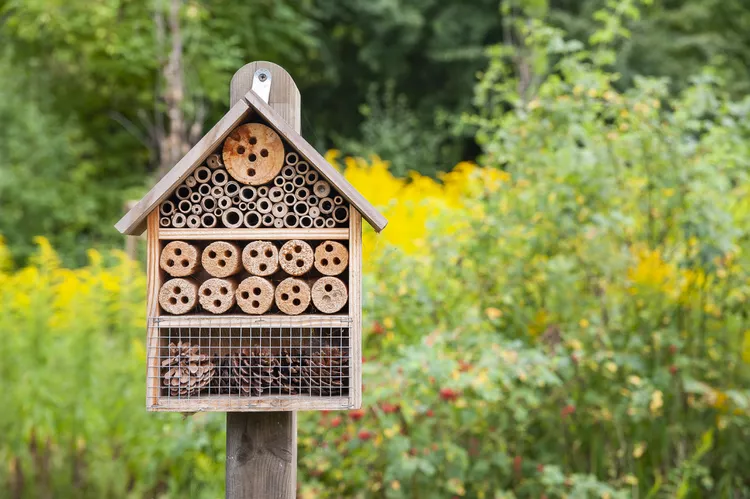
A bee hotel is what it sounds like: a structure that provides shelter for solitary bees. Unlike social species that live in colonies, such as honey bees and bumblebees, solitary bees create individual nests for their larvae. There are about 4,000 species of bees in North America, and a good portion of them prefer nesting in small tunnels like those provided by a bee hotel, says Elsa Youngsteadt, an assistant professor at North Carolina State University.
- Elsa Youngsteadt holds a Ph.D. in Entomology and is an assistant professor at North Carolina State University.
- Rufus Isaacs, Ph.D., is a professor in the Department of Entomology at Michigan State University.
Each spring, solitary bees become diligent nest builders. They lay a single egg in a tunnel, provision it with pollen, and then seal it. They repeat this cycle until the tunnel is full of egg chambers, where the larval bees will remain until they emerge the following spring or summer.
Rest assured, there’s no need to fear solitary bees, says Rufus Isaacs, a professor at Michigan State University; they’re safe to have in your yard. They’re also excellent pollinators that will boost the health and productivity of your garden.
Buying vs. Building a Bee Hotel
You can either buy or build a bee hotel. If you buy one, choose wisely. “One of the common problems I see in some of the commercially available ones is that the tunnels are very short from front to back and they have a really big diameter,” says Youngsteadt. If you’re shopping for a bee hotel, make sure it has tunnels that are 6 to 8 inches long and closed at one end, as bees need a back wall for nesting, she advises. Also, avoid hotels with large-diameter tunnels and pinecones because bees won’t nest in either.
For a more hands-on approach, build your own bee hotel. Bee hotels come in a variety of styles. The birdhouse style resembles a birdhouse filled with removable tunnels. The wood block style is a solid wood block with holes drilled into it.
How to Make a Bee Hotel
For birdhouse-style bee hotels, use a variety of tunnel sizes with diameters ranging from 1/16 to 1/2 inch to attract a variety of bee species. Bamboo is ideal for tunnels since it naturally comes in different diameters. Cut the bamboo into sections and place them in the hotel. Several organizations offer free detailed plans for DIY birdhouse-style bee hotels, such as these from North Carolina State University.
For wood block-style hotels, use different-sized drill bits between 3/32 and 3/8 inch in diameter to create holes that don’t go all the way through, ensuring a closed back. You can find extra-long drill bits suitable for deeper bee hotels at your local hardware store.
When building a bee hotel, always use untreated, natural wood, like pine.
Installation Tips
The correct location is essential for bee hotels. Place your hotel in a sunny location that faces east or southeast to capture the morning sun. The warmth will help bees start their day early.
Bee hotels must also be mounted to a stable location, such as a fence post or the wall of a house or shed. Avoid hanging the bee hotel from swaying tree branches. Install the bee hotel at eye level. “[This height] makes it easy to manage and keeps it out of the way of kids, pets, or small animals,” says Isaacs.
Finally, don’t spray pesticides around your bee hotel. You don’t want to harm the animals you’re trying to help.
Tips for Maintaining a Bee Hotel
Maintenance is a crucial but often overlooked aspect of bee hotels. “You can’t just set it and forget it,” emphasizes Youngsteadt. Regular cleaning prevents the buildup of diseases and parasites. Replace or clean nesting material every two to three years. “No one wants to live in a messy hotel,” adds Isaacs.
Timing the cleaning of a bee hotel is challenging because it’s seldom empty. Bees lay eggs in the spring, and these eggs may not hatch until the following spring or summer. Thus, you cannot simply clean or toss all the tunnels each fall or spring; you’d be killing larval bees. To avoid this issue, the experts recommend using an emergence box.
An emergence box is critical for bee hotel management. It consists of a dark box with a single exit hole, and it temporarily holds old nesting material to allow larval bees time to emerge. Place old nesting material into the emergence box in late winter or early spring. When bees hatch later that spring and summer, they’ll fly toward the light and exit the box.
Cleaning wood blocks is particularly challenging. Youngsteadt suggests lining the tunnels with paper to simplify maintenance. Remove these liners after the bees hatch. Without this method, you will probably need to replace the wood block hotel every few years.
Overwintering a Bee Hotel
Bees naturally overwinter outdoors, so it’s safe to leave your bee hotel and emergence box outside during the winter months. Avoid moving them into a warm or heated area, as this could prematurely awaken the bees from dormancy.
Providing Nesting Habitat Naturally
Bee hotels are a fun way to support bee populations. However, if you prefer a less hands-on approach, provide a natural nesting habitat instead. In nature, solitary bees nest in hollow plant stems or cavities in dead wood, so postpone your garden’s spring cleanup to protect hibernating bees and leave dead wood and dried plant stems in place. This reduces your workload and helps sustain your local bee populations.
Remember, patience is key. “If you don’t see bees in the first season, don’t give up. It can take a while,” says Isaacs. Give your local bees time to discover and make use of the new habitat you’ve provided. With persistence and care, your garden can become a thriving sanctuary for these vital pollinators.